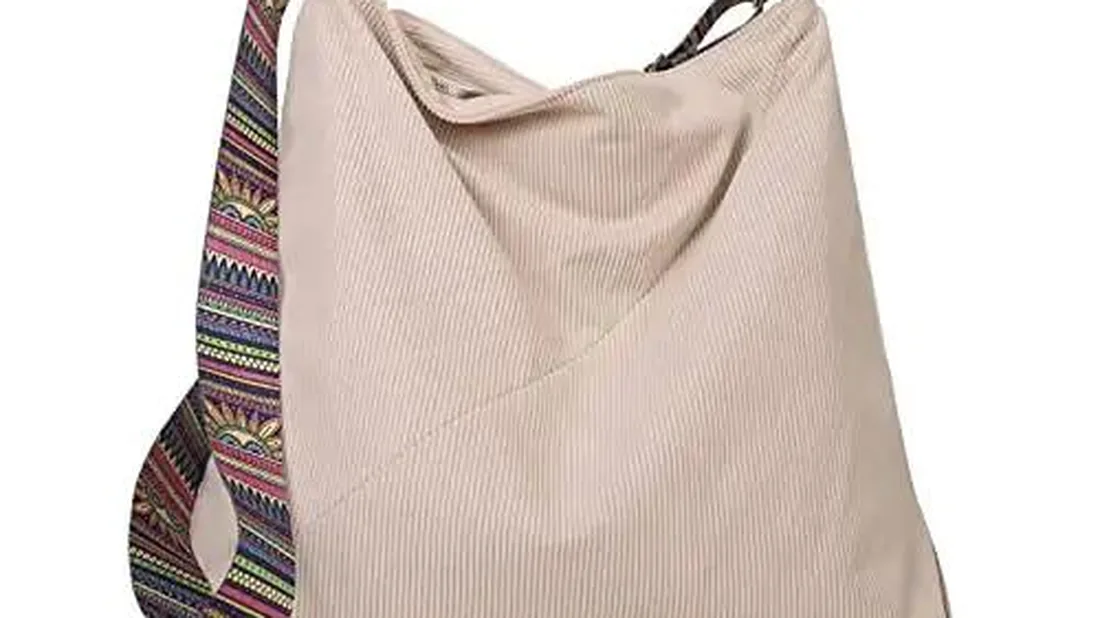
Buying wholesale handbags is not one decision. It is a stack of small ones, and the stack is what separates a range that sells from a pallet of dead stock. Say you run a boutique with two hundred regular customers and one open wall. You need product on that wall in weeks, not quarters. Now imagine the opposite case: a private-label brand with a logo, a photographer booked, and a firm view of what the bag should feel like. Those two buyers should not place the same order, and they should not ask a factory the same questions.
What follows is the working version. No hype, no brand mythology, just the parts of the process that decide whether the carton that lands is the carton you approved.
Stock Designs or Custom Development: Which Route Fits Your Store
A stock style is an existing shape already cut, sewn and packed. You pick colours and trims, add a label, and ship. Speed is the whole point. The pattern is proven, the cost is known, and the risk sits with whoever developed it rather than with you. What you give up is exclusivity: another shop three streets away can order the same body next month.
Custom development flips that. You get your own silhouette, your own hardware, your own lining, your own label. Nobody else can buy it. You also inherit every cost of being first: pattern making, sampling rounds, material minimums, and the possibility that the shape you drew does not actually sit well on a shoulder.
Private-label brands usually split the difference. They start from a stock shape, then change the materials, colours and trims until the bag reads as theirs. That is a rational move, not a lazy one. The silhouette is the expensive part to get wrong, and the surface is the cheap part to make distinctive. A tote handbag in a heavier canvas with a different edge finish and a metal plate looks nothing like the same tote in coated polyester.
The trade-off is cash, time and commitment, and it is a decision rather than a recommendation. If your margin depends on turning product fast, stock wins. If your margin depends on nobody being able to copy you, custom wins. Most buyers end up running both: stock to keep the shelves moving, custom to build the brand.
Materials: PU, Genuine Leather, Canvas and Textile Compared
Four families cover most of the market, and each one reads differently the moment a customer picks it up.
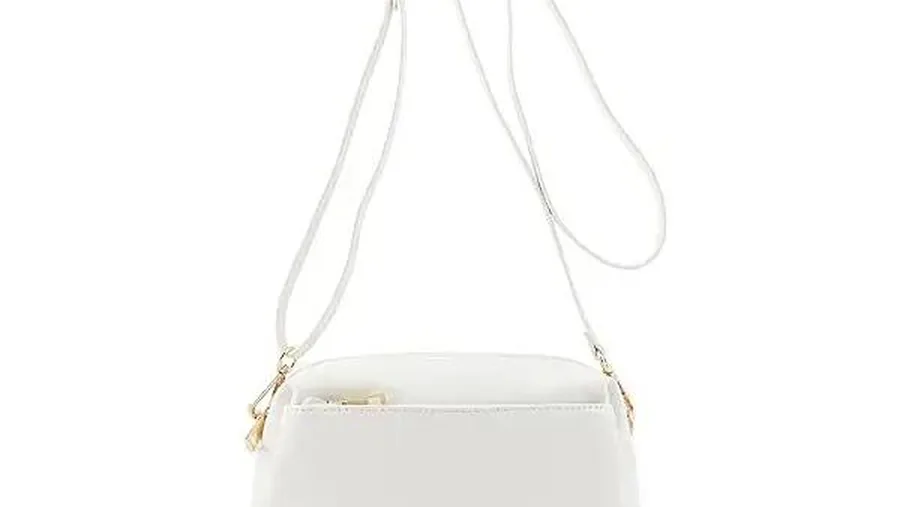
PU, or polyurethane-coated material, is a coated composite on a textile backing. On the shelf it is uniform: even grain, even sheen, no natural variation. That consistency is a selling point for a buyer who needs forty units to look identical. In use, the watch items are flex cracking along fold lines, edge wear where the coating meets the seam, and colour transfer onto light clothing. Care is simple. Wipe with a damp cloth, keep it out of prolonged heat, and do not condition it.
Genuine leather is a natural material, and it behaves like one. Grain, temper and colour vary between hides, and it ages rather than stays still. Abrasion resistance is generally good, but the failure modes are different: scuffing, darkening at high-contact points, and edge wear that shows as the finish rubs back. Care means cleaning, conditioning and storing it away from damp. Buyers who want a range where every unit looks the same should know that leather will not give them that, and that customers who buy leather usually do not want it.
Canvas is a plain-woven fabric, often cotton or a blend, chosen for structure and texture. It shows weave and slub, it softens with use, and it takes print and embroidery well. The durability question is usually about surface soiling rather than structural failure. Spot clean, avoid soaking the whole bag, and accept that a pale canvas will show the world.
Textile covers the synthetic wovens: polyester, nylon, ripstop. These are dimensionally stable, printable and available in a wide spread of weights and coatings. They are the lightest option and often the most weather-resistant once coated. They also feel the least like leather, which matters to some customers and not at all to others.
| Material | How it looks | Durability consideration | Care for the end buyer |
|---|---|---|---|
| PU / coated composite | Uniform grain and sheen, consistent unit to unit | Flex cracking on fold lines, edge wear, colour transfer | Wipe clean, no conditioner, avoid prolonged heat |
| Genuine leather | Natural variation, develops a patina over time | Scuffing, darkening at contact points, finish rub at edges | Clean and condition, store dry, expect change |
| Canvas | Visible weave and texture, softens with use | Surface soiling more than structural failure | Spot clean, do not soak, accept marking |
| Textile (polyester, nylon, ripstop) | Even, technical surface, wide colour range | Coating wear and abrasion at corners and base | Wipe or hand wash per care label, air dry |
Hardware and Lining: The Details That Separate Good From Cheap
Hardware is where a cheap bag announces itself. Not by the logo on the puller, but by how the zipper runs. A zipper is a chain, a slider and a puller, and the smoothness comes from how those three are matched to each other and to the tape. A slider that catches, a chain that skips a tooth, a puller that twists: all of these are felt in the first ten seconds of handling, long before a customer looks at the price.
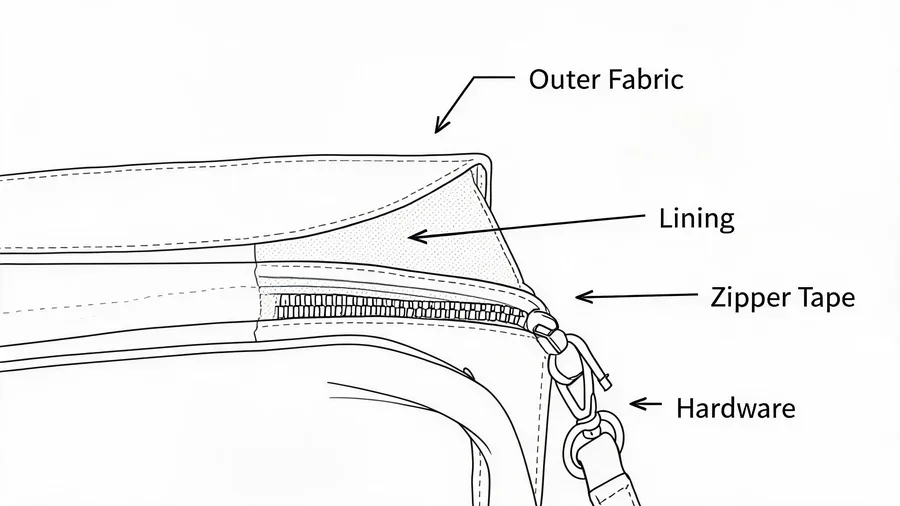
Plating matters just as much. Rings, hooks and buckles should hold a consistent colour across the whole order, because a bag with three shades of gold on it looks broken. Ask about tarnish resistance and about sharp edges on the underside of hardware, which is where fingers and linings get damaged.
Then there is the load path. A strap does not attach to a bag, it attaches to a reinforced point on a bag. Look for a reinforcement patch, a box-X stitch, a rivet or a D-ring that is anchored into structure rather than into a single layer of face fabric. The lower anchor usually carries more force than buyers expect, especially when someone lifts the bag by one strap.
Lining decides how the inside feels and how the bag holds its shape. A heavier lining stiffens a soft body; a lighter one keeps it collapsible. Cleanability matters too: a light lining in a dark bag shows every mark, and a coated lining wipes down where a plain woven one does not. None of this is visible in a product photo, which is exactly why it is worth specifying.
How Sampling Works Before a Bulk Run
Sampling is a ladder, and each rung answers a different question.
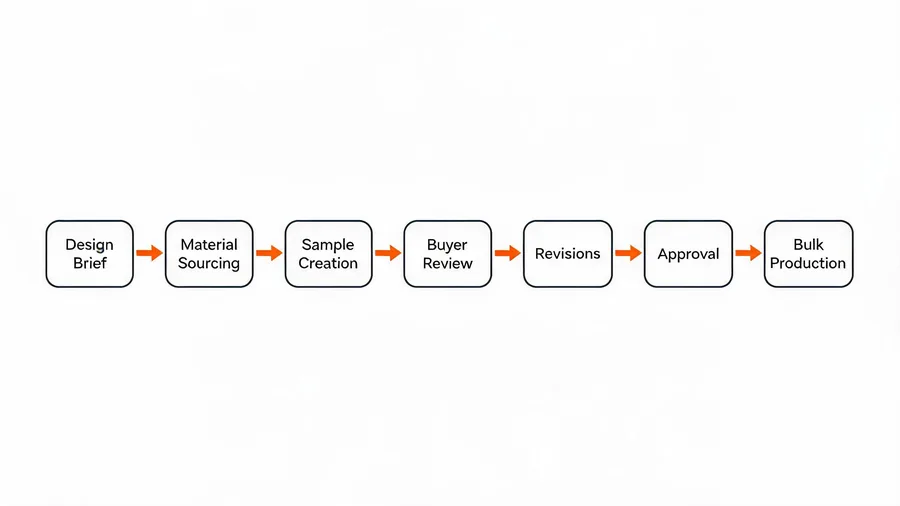
A proto sample tests concept, shape and construction. It is early, it is rough, and it is not for showing to customers. A fit sample tests wear: strap geometry, access, how the bag sits against the body. A lab dip approves colour on the actual material before bulk dyeing, and a strike-off approves printed artwork, scale and registration. The pre-production sample is made with intended bulk materials and approved methods, and it is the last point at which changing your mind is cheap.
The golden sample is the one that matters most. It is the approved physical reference, and it should be sealed, labelled and kept. Every later argument about whether a production run is acceptable is really an argument about whether it matches that bag.
Two documents make all of this repeatable. The tech pack is the controlled specification: dimensions, materials, construction, artwork, labels, packaging and test requirements. The bill of materials lists every material, component, quantity, colour and supplier reference in one product. Without them, sampling is a conversation. With them, it is a process.
Spec Sheets: Writing a Brief Two Suppliers Can Quote
If two suppliers quote the same brief and the prices are far apart, the brief is usually the problem.
Write dimensions as numbers with tolerances, not as adjectives. Mark the critical dimensions, the ones that affect fit, function or component compatibility, and leave the rest looser. Specify fabric in the language the mill uses: denier for synthetic yarns, GSM for mass per area, fabric count for weave construction, coating weight, and thickness measured under a stated pressure. Add hand feel in words if it matters, because two fabrics with identical numbers can feel entirely different.
Control colour through a physical or digital colour standard, approve it with a lab dip, and state the tolerance you will accept. List hardware, lining, labels, packaging and test requirements in the same document. A spec sheet that leaves any of these open will be filled in by the supplier, and not always in your favour.
Inspecting Wholesale Handbags on Arrival
Eyeballing a carton is not an inspection. A workable plan has three parts: a sampling plan, a defect classification, and the golden sample on the table.
Start with stitching. Check stitch density against the approved sample, look for skipped stitches, confirm back-tacking at stress points, and check that seams align where panels meet. Move to edge finishing. Turned, bound, painted and raw edges all behave differently over time, and the question is whether the edge on the bag in your hand matches the edge on the bag you approved.
Then hardware and stress points. Run every zipper the full length. Check plating colour across units. Load the strap anchors and the base, because that is where a bag fails first. Finally, classify what you find as critical, major or minor, and apply an AQL sampling plan with acceptance numbers agreed before the order, not after. The exact values belong in the approved specification, not in a memory of what someone once accepted.
Working With Wholesale Handbags Suppliers: Questions to Ask Early
The first question is the one most buyers skip: who actually makes the bag? A trading company and a factory answer differently, and the answer changes everything downstream, from how fast a change can be made to who owns the pattern.
Ask about material sourcing, in-house capability and change control. Ask how minimum order quantity, sampling and lead time interact, because the cheapest quote is often the least specific. Then request documentation before a first order: a spec sheet, a bill of materials, a sample policy, and a written change process. Two quotes compared against the same documents are comparable. Two quotes compared against a photo are not.
For stock shapes, browse the handbag range and the leather styles, or read more about wholesale terms. When your brief is ready, send the spec through those pages and ask for a quote.
Contact details, for reference: [email protected].
Frequently Asked Questions
Where can I find the best wholesale handbags suppliers for a boutique?
Look for suppliers who can show you the factory, not just the catalogue. Ask who cuts and sews the bag, what materials they source directly, and how they handle a change request mid-order. A supplier who answers those three questions in specifics is worth more to a boutique than one with a prettier lookbook, because a boutique's problem is usually small runs and fast turns, not the lowest price per unit.
Where can I buy handbags wholesale if I want my own label rather than stock designs?
You need a supplier who will develop from a tech pack and a bill of materials rather than sell you a finished style. That means sampling, a colour standard, and a golden sample kept as the production reference. Start from an existing shape if you want to reduce risk, then change the materials, hardware and trims until the bag carries your label rather than someone else's.
Can I buy wholesale handbags online and still control materials and hardware?
Yes, but only if the specification is written down before the order. Denier, GSM, coating weight, thickness, hardware finish and lining are all things you can pin in a spec sheet. If a supplier will not put them in writing, you are not controlling them, you are hoping. Approve a lab dip for colour and a pre-production sample for construction, and keep both.
How do I buy handbags in bulk without over-ordering styles that will not sell?
Split the order. Put most of your budget into a small number of proven shapes in core colours, and use the remainder to test new silhouettes in low quantities. Test at the colour and trim level rather than the shape level, because a new colour on a proven body is a cheap experiment and a new body is an expensive one. Reorder what sells, and let the rest run out.