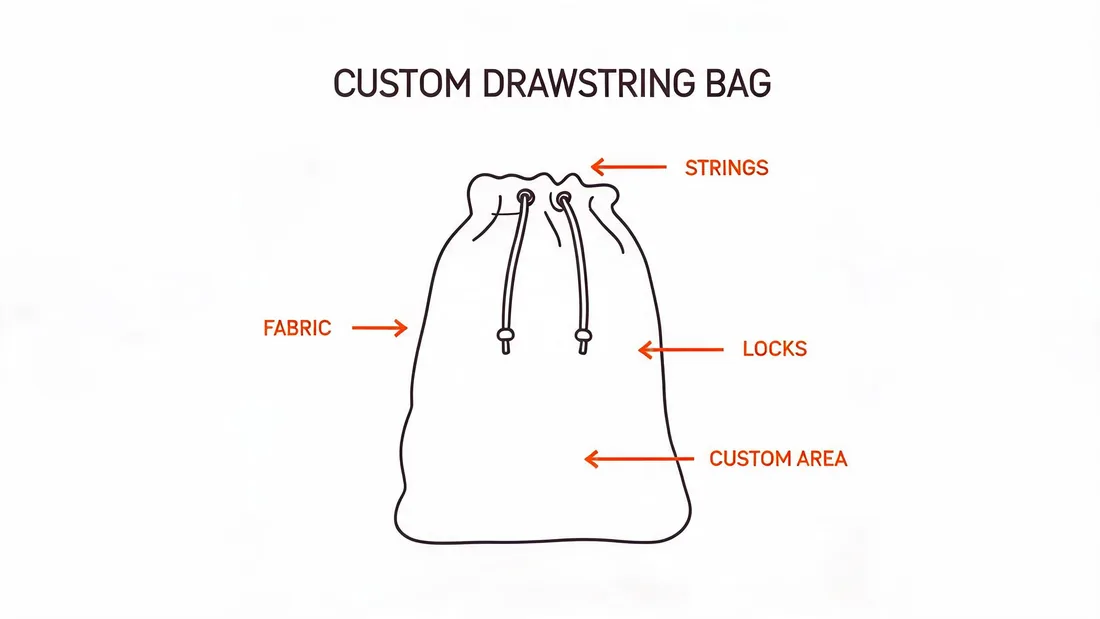
Say a gym chain needs two thousand drawstring bags for a member drive. The buyer has a logo file, a colour, and a date. What that buyer doesn't have is a specification. That gap is where most custom drawstring bag projects get expensive.
A drawstring bag looks like the simplest thing in the bag catalogue. It isn't. Fabric weight, cord construction, decoration method and tolerance all interact. The choices you make in week one decide what the factory can quote in week three.
This guide walks through the decisions in the order a factory actually needs them. It assumes you're ordering drawstring bags bulk, not buying a hundred pieces for a one-off event, though the same logic applies at both scales.
Start With the Use Case, Not the Bag
Three buyers, three different bags. A running event needs something light that folds into a pocket and survives a wet morning. A gym programme wants a bag that holds shoes, a towel and a bottle without the base sagging. A retail brand wants a bag that photographs well on a shelf and feels substantial in the hand.
Those aren't the same product, even though all three get called a drawstring bag.
Load and carry time decide fabric weight before anything else. A bag that sits on a shoulder for ten minutes at a trade show can be lighter and softer. A bag that hangs on a back for an hour with a laptop and a water bottle needs a heavier shell and a reinforced base. Without those, the seams will tell you about it in the second month.
Write these down before you approach any supplier:
- What goes inside, and roughly how heavy that is
- How long it is carried in one stretch
- Whether it gets wet, dragged, or stuffed into a locker
- Whether it must stand up on a shelf or lie flat in a shipping carton
- Where the logo goes and how large it is
- What the bag must not do (fade, bleed, fray at the cord channel)
That list is the seed of a tech pack. The Industry Reference defines a tech pack as the controlled product specification containing dimensions, materials, construction details, artwork, labels, packaging and test requirements. Everything downstream is quoted from it.
Choosing Fabric: Polyester, Nylon, Cotton and Non-Woven
Polyester is the default for promotional drawstring bags, and for good reason. It's dimensionally stable, widely printable, and available in a wide range of weights, weaves, coatings and recycled-content options. A 210D polyester and a 600D polyester are both polyester. They behave nothing alike.
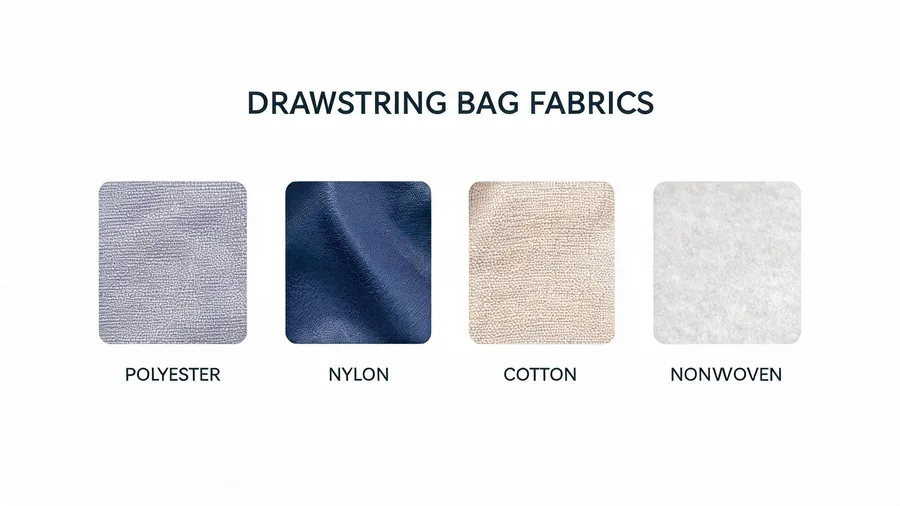
Nylon brings higher strength-to-weight performance and good abrasion resistance. Weave and coating change its water resistance far more than the fibre name does. A coated nylon ripstop sheds a light shower. An uncoated nylon weave will not.
Cotton and cotton duck give you structure, texture and abrasion performance. Cotton duck is a tightly woven canvas with a smooth, firm face and closely packed yarns. That's why it holds a screen print crisply and stands up in a tote-style drawstring bag. It also costs more and takes longer to print.
Non-woven fabric is a sheet structure made by bonding fibres rather than weaving or knitting. It's common in low-cost event bags, backing layers and reinforcement. It isn't a substitute for a woven shell if the bag has to carry real weight.
| Material | Best fit | Watch out for |
|---|---|---|
| Polyester (light to mid weight) | Event and promotional bags, full-colour print | Thin hand feel; check coating if water resistance matters |
| Polyester (heavy weight, e.g. 600D) | Gym and retail bags, structured base | Higher cost, stiffer fold, longer print setup |
| Nylon | Lightweight performance bags, packable designs | Cost; water resistance depends on coating, not the fibre |
| Cotton / cotton duck | Retail, premium giveaway, crisp screen print | Weight, shrinkage control, print penetration |
| Non-woven | Low-cost event bags, liners, reinforcement | Limited strength and abrasion life |
| Ripstop | Bags that must resist tearing | Grid pattern may show through light prints |
Specification vocabulary matters here. Denier is a yarn linear-density unit used to describe synthetic bag fabrics. It doesn't directly state finished-fabric strength. GSM is grams per square metre, used for fabric, film, nonwoven and composite mass per area. Fabric count describes warp and weft yarns per unit length. Coating weight is the mass of coating per unit area or the total coated-fabric mass, as defined in the specification.
Hand feel covers softness, stiffness, smoothness and drape. Colourfastness is resistance to colour change or transfer during rubbing, washing, light exposure or contact with moisture. Ask for both to be written into the spec, not agreed verbally.
Drawcord, Hardware and Closure Choices
The cord is the part of a drawstring bag that touches a human being most. Cord thickness and construction affect comfort on the shoulder directly. A flat cord spreads load and sits still. A round cord of the same nominal size digs in more. It also slides through a channel faster.
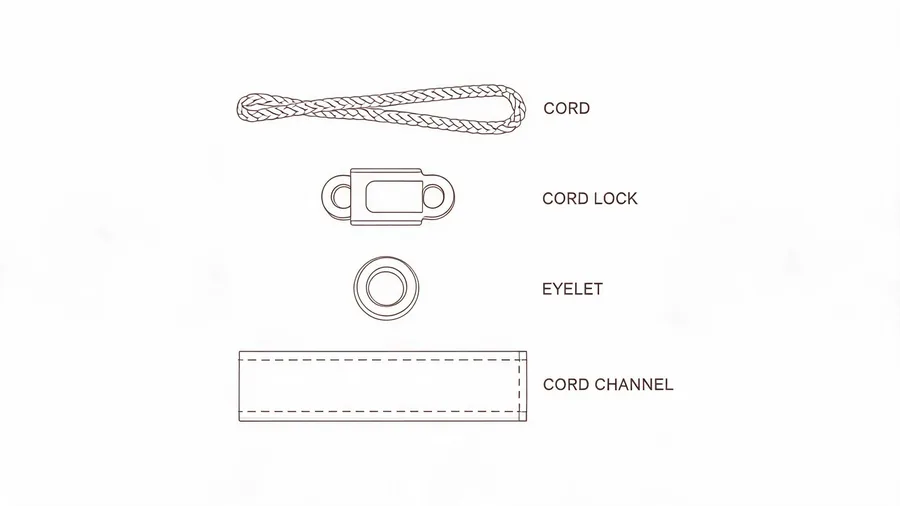
Closure hardware is a short list, and each option suits a different job:
- Simple cord loop: lightest and cheapest, fine for a promotional bag, awkward to open one-handed
- Plastic cord-lock (toggle): holds the bag closed under load, standard for gym and outdoor use
- Metal cord-lock: heavier, more premium feel, adds cost and a small metal-detection consideration for some retail programmes
- Spring cord-lock with a pull tab: easiest to operate with cold or gloved hands
- Drawcord with a side-release buckle: turns the bag into a wearable pack, adds hardware and stitching steps
Match the cord colour against the body fabric, not against the artwork file. A cord chosen in isolation almost always reads as a slightly different shade once it's next to the shell. Cord yarns and fabric yarns are dyed and finished differently. Approve them together.
Where the cord meets the bag
The cord channel, or casing, is the highest-stress seam on most drawstring bags. Reinforcement patches at the cord exit points are standard practice for anything carrying more than a few kilos. If the bag is lifted by one cord, that single anchor point takes the whole load. That's where failures start.
Print, Embroidery and Other Decoration Methods
Screen printing forces ink through a prepared screen onto the material. It suits solid colours and repeat production when the substrate and ink system are compatible. That's why it remains the workhorse for event runs.
Digital textile printing deposits ink by controlled inkjet. It supports detailed graphics and shorter runs, with ink chemistry selected for the fibre type. Dye sublimation is a transfer process in which disperse dye becomes a gas and bonds with suitable polyester surfaces under heat and pressure. Sublimation on polyester gives full-colour coverage that doesn't sit on top of the fabric. On cotton it doesn't work the same way.
Embroidery stitches thread into the material to create a durable raised design. Backing, needle selection, stitch density and panel distortion all require control. On a light drawstring bag, a dense embroidered logo can pull the panel out of shape. The backing and stitch count are specification decisions, not decoration details.
Heat-transfer graphics apply a prepared graphic with heat and pressure. Adhesion, stretch, wash and abrasion performance must be validated on the actual fabric, not assumed from the supplier's data sheet.
Debossing and embossing form recessed or raised marks by pressure, sometimes with heat. They read well on synthetic leather patches and structured panels. They read poorly on thin woven shells.
Artwork Setup, Colour Approval and Sampling
This is the section most catalogue pages skip. It's where a bulk order is won or lost.
Artwork files should arrive as vector where the design allows it, because vector scales without losing edges. Raster files are workable for photographic or full-colour work, but resolution has to be adequate for the final print size. That's checked before anything is quoted. Send the file, the intended print dimensions, and the placement on the bag.
The approval chain runs in a fixed order:
- Colour standard: the approved physical or digital reference used to evaluate production colour
- Lab dip: a small dyed material sample submitted for colour approval before bulk production
- Strike-off: a printed sample used to approve artwork, colour, scale, registration and print quality
- Proto sample: an early sample used to evaluate concept, shape, construction and initial dimensions
- Fit sample: a sample used to evaluate wear, access, strap geometry and ergonomic relationship to the user
- Pre-production sample: a sample made with intended bulk materials and approved methods before mass production begins
- Golden sample: the approved physical reference used to compare production workmanship and appearance
Buyers often collapse these into one word, sample, and then wonder why the first bulk run looks different from the bag they approved. A proto sample proves the idea. A pre-production sample proves the method. They aren't interchangeable.
Sampling is paid, and that's normal. One revision round typically takes two to three days to turn around, and most first-round changes are small: cord colour, print placement, a seam allowance, a panel dimension. Agree the tolerance and critical dimension in writing before the pre-production sample is signed off. A critical dimension is one that directly affects fit, function, component compatibility or safety. It deserves a tighter tolerance than a cosmetic measurement.
Ordering in Bulk and Scaling a Programme
MOQ is set by material, component, colour or finished product, not by the bag alone. That single sentence explains most MOQ confusion. A supplier may be able to run a small quantity in a stock fabric and a much larger one in a custom-dyed shell. The constraint sits with the material, not the sewing line.
Splitting colours across a bulk run changes what a supplier can quote. Three colours in one order means three cutting lots, three print setups and three sets of quality checks. Sometimes that's the right call. It should be a deliberate one.
Lead time is elapsed time for a defined sourcing or production activity, so it only means something when the activity is named. Sampling lead time, material lead time and production lead time are different numbers. A supplier who quotes one figure for all three isn't giving you a plan.
If you're building a programme rather than a single order, look at the related categories early. A drawstring backpack programme shares cord, hardware and print decisions with the flat drawstring bag. Running both through one specification saves a full approval cycle. Tote programmes overlap in the same way, which is worth reading about in the custom tote bags guide.
When the spec is ready, send it through the contact page for a quote. A one-page spec with dimensions, fabric, cord, decoration and packaging gets a usable answer. A logo and a quantity gets a guess.
Inspection, Tolerances and Change Control After Approval
Inspection starts with AQL, the acceptance quality limit, used with a sampling plan to determine inspection sample size and acceptance numbers. The specific sampling values belong in the approved specification and in the inspection agreement, not in a general guide. They depend on the product and the risk.
Defect classification drives acceptance. Critical, major and minor severity is assigned based on risk and product impact. A broken cord-lock on a gym bag isn't the same class of problem as a faint print edge. The two should not be counted the same way.
Workmanship standards cover sewing, trimming, cleanliness, symmetry and assembly. Ask any supplier for their documented workmanship standard before the order, not after the first shipment. If they can't produce one, that tells you something useful.
Change control is the documented approval process for revisions to materials, patterns, construction, artwork, tests or packaging. Change a cord supplier, and the colour may shift. Change a print method, and the wash performance may shift. Anything that moves after approval should go back through the chain. The golden sample is the reference held against production.
That's the whole discipline in one line: agree the spec, approve the sample, freeze the reference, and inspect against it.
Ready to price a run? Send the specification through the contact page and the factory can quote against real numbers instead of assumptions.
Frequently Asked Questions
Where can I get custom drawstring bags?
From a bag factory that runs drawstring bags as a standard construction rather than an occasional job. Look for a supplier who can show you the cord channel construction, the reinforcement at the cord exit, and a documented workmanship standard. Ask what decoration methods they run in-house and which they subcontract. The linked contact page is the place to send a spec and get a quote.
How do I make my own drawstring bag?
You start with a tech pack, not a sketch. That document lists dimensions, fabric and weight, cord type and thickness, cord-lock hardware, decoration method, placement, packaging and any test requirements. Add a bill of materials covering every component and colour. The factory quotes and samples from those two documents. The approval chain runs from colour standard through lab dip, strike-off, proto sample and pre-production sample to a signed golden sample.
How much does it cost to make a custom bag?
Cost depends on fabric weight and type, cord and hardware, decoration method, print colours, packaging and order quantity, and no honest figure can be given without those. Two bags that look identical online can differ substantially once one uses a coated heavy-weight shell and a metal cord-lock and the other uses a light uncoated shell and a simple cord loop. Send the specification through the contact page and the quote will be built from actual materials.
How much does a drawstring bag cost?
The same answer applies. Price is driven by the specification, not the category name. A promotional drawstring bag in a light fabric with a one-colour screen print sits at a very different point from a gym bag in a heavy coated shell with a reinforced base, a cord-lock and a multi-colour print. Quantity also changes the picture, because setup costs are spread across the run. Confirm the figure against your own spec rather than a generic range.